Agentic AI for Faster Enterprise Application Development
Most organizations have no shortage of promising application ideas. The real challenge is turning those ideas into secure, reliable and scalable solutions quickly enough to create measurable value.
Traditional enterprise software development can involve lengthy planning cycles, manual handovers, repetitive engineering tasks and delayed testing. Meanwhile, development teams are expected to reduce technical debt, meet security and compliance requirements, and deliver greater business impact under increasing time pressure.
Agentic AI introduces a more advanced approach to software delivery. Instead of supporting developers only with code suggestions, AI agents can contribute across the entire development lifecycle, from requirements analysis and planning to testing, documentation, DevOps and release preparation.
Rather than replacing human judgement, this structured delivery model uses AI to accelerate execution while experienced professionals retain control over architecture, security, quality and production readiness.
From AI-Assisted Coding to Agentic Software Delivery
The first generation of AI development tools was largely confined to code completion, helping developers accelerate routine tasks such as writing functions, detecting syntax errors and producing basic technical documentation. Agentic AI represents the next stage of this evolution, extending AI support beyond individual coding tasks to the entire software delivery lifecycle.
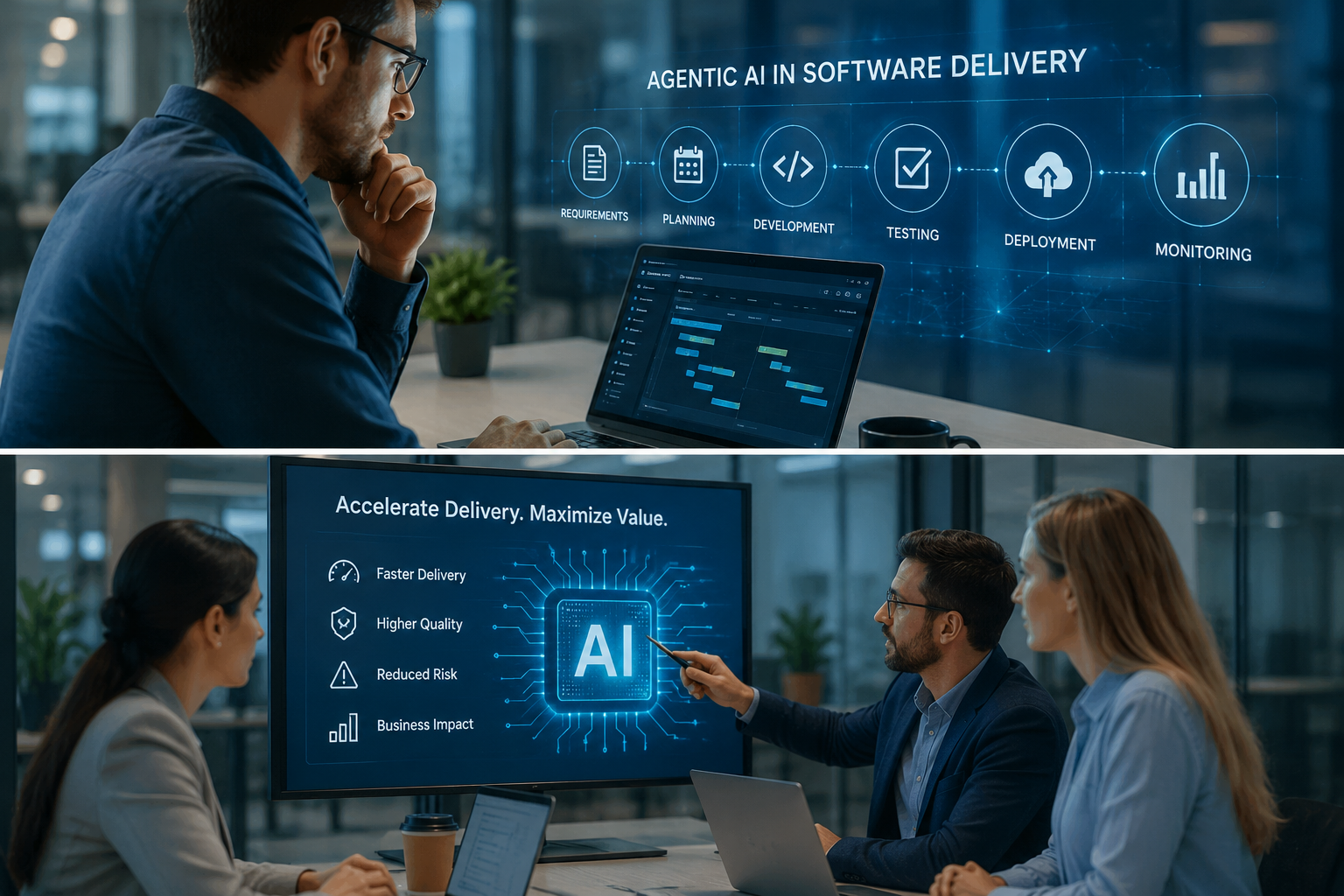
AI agents can analyze requirements, break down tasks, support backlog refinement, generate and refactor code, create tests, investigate errors and assist with deployment preparation. Instead of operating as an isolated coding tool, AI becomes part of an integrated software delivery process. This creates opportunities to improve several stages of enterprise application development simultaneously.
- Planning and requirements analysis
AI agents can support the creation of requirement catalogues, identify missing information and transform business needs into structured development tasks. These advantages help teams move from loosely defined ideas toward a realistic application scope more efficiently.
- Development and integration
During implementation, AI can assist with code generation, refactoring and repository workflows. Integration with tools such as Figma and GitHub can also reduce friction between design, development and technical delivery.
Developers remain responsible for the solution but spend less time on repetitive engineering work.
- Testing and quality assurance
Testing is often delayed until later stages of development, increasing the cost of identifying and resolving defects.
AI-supported test generation, Playwright automation, static code analysis and agent-assisted bug fixing allow quality checks to become a more continuous part of the development lifecycle.
- DevOps and release preparation
AI agents can also support CI/CD pipelines, deployment scripts, technical documentation and release readiness, which improves consistency and reduces the manual effort required to move an application toward production.
Why Enterprise Agentic AI Is Not “Vibe Coding”
Rapid AI coding experiments can be useful for exploring ideas, but enterprise applications require a fundamentally different level of control.
Business-critical systems must meet architectural standards, security requirements, quality expectations, integration needs and regulatory obligations. An application that works in a demonstration is not necessarily ready for real users, production data or enterprise operations.
A controlled Agentic AI delivery model therefore requires:
- secure and approved development tools,
- clearly defined engineering standards,
- architecture and code reviews,
- automated testing and static analysis,
- governance and quality checkpoints,
- human approval for production releases.
AI agents accelerate the repetitive and time-consuming elements of software delivery. Human experts continue to control the decisions that determine whether the resulting application is secure, maintainable and fit for purpose.
What Business Results Can Agentic AI Development Deliver?
The true value of Agentic AI lies not in accelerating code generation alone, but in improving performance across the entire software delivery lifecycle. Its wider potential comes from improving delivery performance across planning, implementation, testing and release management.
In an Abylon customer project, a Shift Planner application was designed, implemented, tested and released for a large international retail company using Claude Code as part of Abylon’s Agentic AI Driven Delivery model.
The browser-based application supported workforce planning, shift management, productivity visibility, role-based administration and enterprise integrations within a complex, multi-country and GDPR-compliant environment.
To become a reliable digital colleague, an AI agent must operate within a secure platform, understand trusted business information and follow clearly defined rules.
Where Should Organizations Start?
Adopting Agentic AI does not require an immediate transformation of the entire software development organization. A targeted prototype offers a practical, lower-risk way to validate the approach, demonstrate business value and build confidence before committing to full-scale delivery.
- Start with a meaningful business objective
The strongest opportunities begin with a clear operational or commercial problem. The purpose should not be to experiment with AI for its own sake, but to create a working solution that stakeholders can evaluate.
- Select a valuable but manageable scope
A prototype should cover a limited part of the proposed application while still demonstrating meaningful functionality. This could include a core workflow, selected integrations or a specific user journey.

Building Enterprise Applications with Agentic AI
Agentic AI is clearly changing the economics and structure of software delivery. It can help organizations shorten development cycles, make better use of specialist capacity, improve backlog execution and strengthen documentation and testing discipline. It can also support more predictable delivery by reducing the manual effort required across the application lifecycle. Realizing the full potential of Agentic AI requires more than technology alone.
Successful enterprise adoption requires a combination of AI capabilities, experienced development teams, secure infrastructure, engineering standards, quality controls and clear governance.
Abylon brings these elements together in an end-to-end Agentic AI Driven Delivery Process covering discovery, architecture, design, development, testing, QA, DevOps and release.
Explore how Agentic AI can accelerate enterprise business application development while maintaining security, governance and human control. The white paper covers Abylon’s delivery model, engagement options, customer results in numbers and the recommended approach for starting with a Rapid Prototype Sprint.
Download “Rapid Business Application Development with Agentic AI” and discover how to turn a business requirement into a working application faster.

Author of the post:
Attila Dömsödi - Head of Application Development at Abylon Consulting. Linkedin Profile