Legacy systems often play a much bigger role in business operations than they appear from the outside. They support customer-facing services, financial processes, reporting, internal workflows, integrations, and critical day-to-day operations.
For many organizations, these systems have been running successfully for years. But over time, the same applications that once created stability can become a barrier to growth, scalability, innovation, and AI adoption.
Legacy system modernization is about creating a stronger, more flexible, more transparent foundation for the future of the business.
Why Modernization Matters
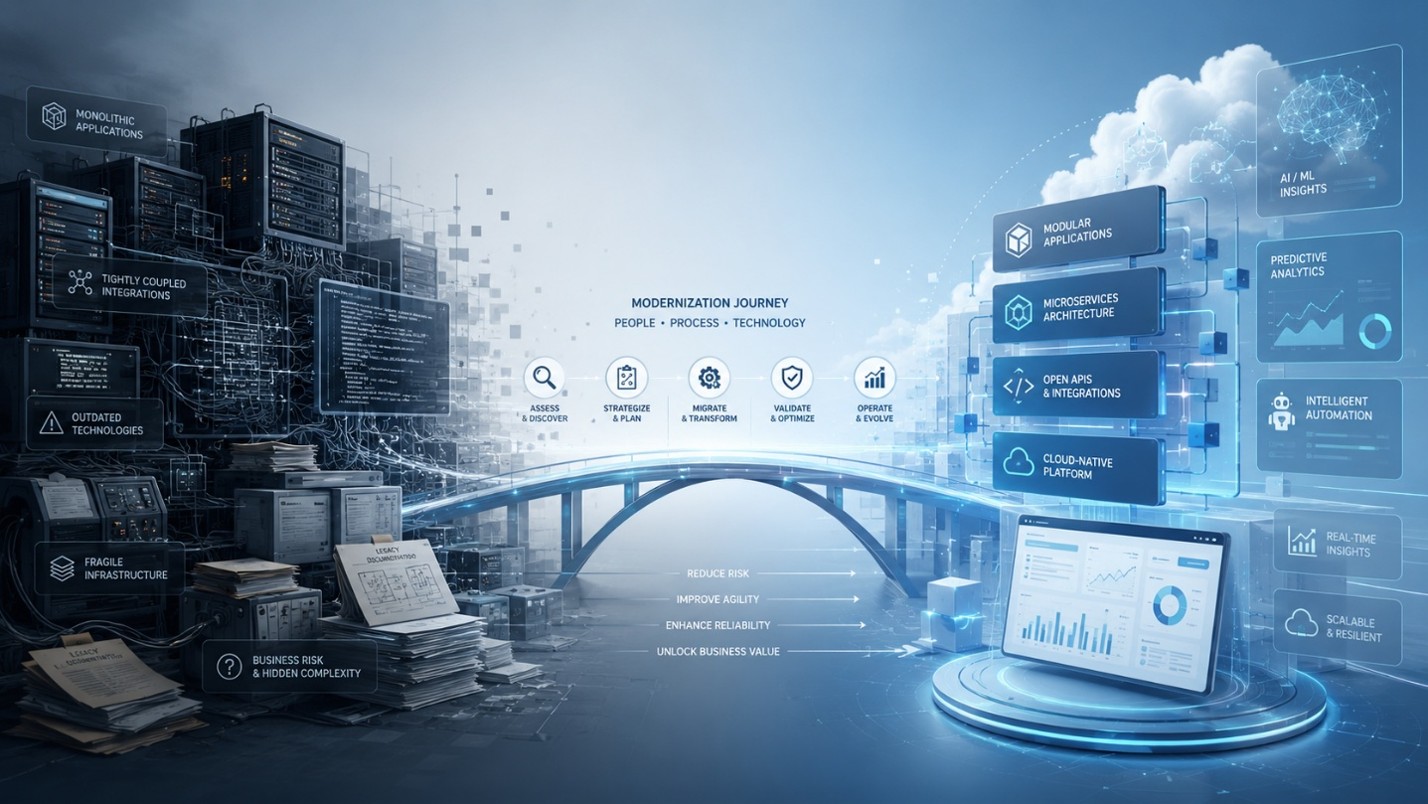
Modernization projects are often delayed because legacy systems are business-critical. They contain years of custom logic, integrations, business rules, and operational knowledge. In many cases, documentation is incomplete, dependencies are hidden, and key knowledge sits with a small number of experts.
This creates risk and lack of trust in the old system.
Nowadays new business requirement is becoming harder to deliver, and every integration takes longer and changes require more investigation. Over time, the organization becomes slower, less flexible, and more dependent on outdated technology.
Modernization helps address these challenges by improving visibility, reducing complexity, and making critical systems easier to maintain, scale, and evolve.
The Business Benefits of Legacy System Modernization
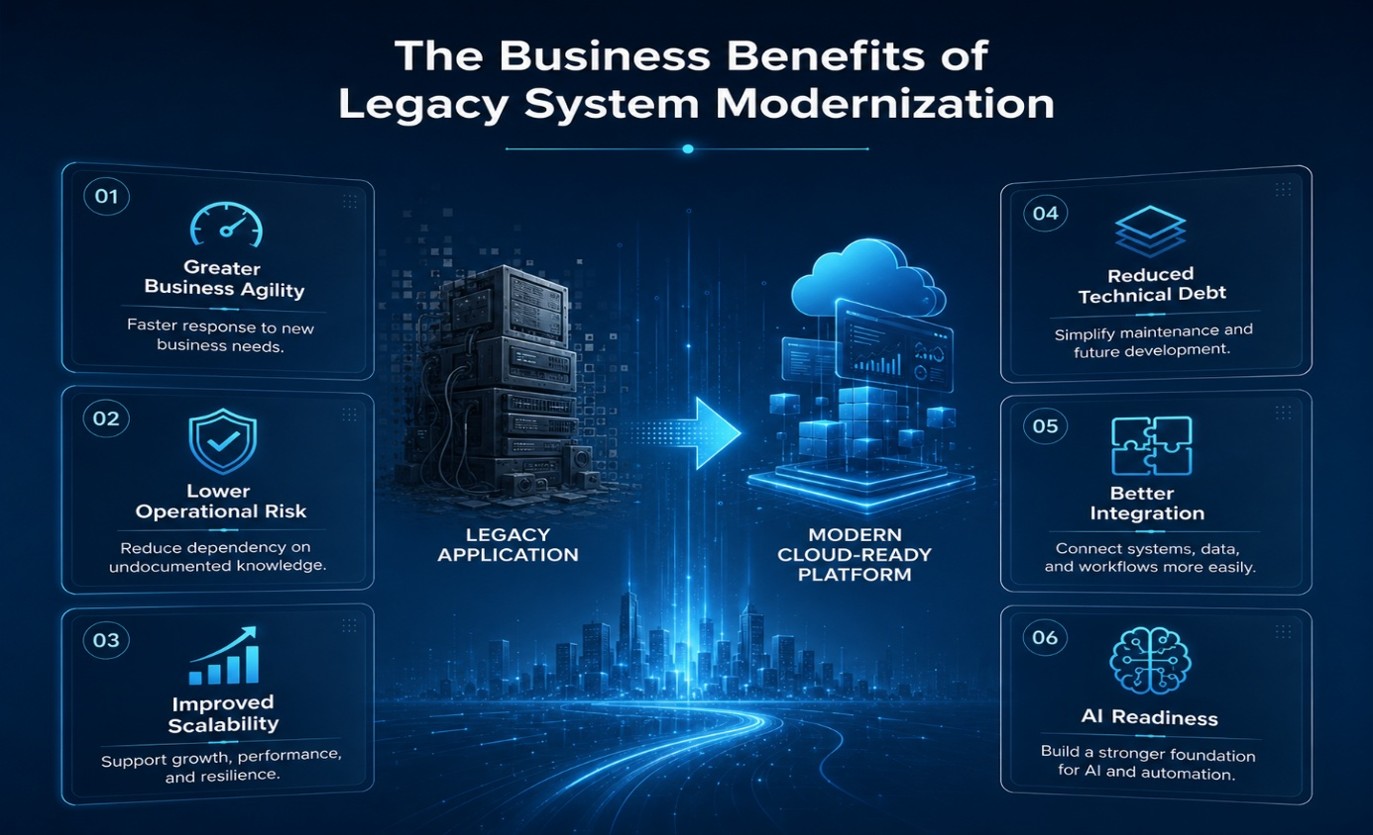
Greater Business Agility
Modernized applications allow organizations to respond faster to new business needs. Instead of struggling with rigid legacy architecture, teams can introduce new features, integrations, and services more efficiently.
This is especially important in markets where customer expectations, regulatory requirements, and competitive pressure are constantly changing.
Lower Operational Risk
In many legacy environments, critical system knowledge has developed over time through practical experience, custom decisions, and evolving business needs. When this knowledge is only partially documented or concentrated within a small group of experienced specialists, organizations may face continuity risks and slower change processes.
Platform evolution helps to make system knowledge more transparent. By uncovering dependencies, documenting business logic, and improving architecture, organizations can reduce reliance on individual experts and improve long-term stability.
Improved Scalability and Performance
Many legacy applications were not designed for today’s usage patterns, data volumes, or digital service expectations.
Enterprise application transformation can improve scalability, performance, and resilience. Whether through cloud migration, Azure modernization, replatforming, refactoring, or API enablement, organizations can create systems that are better prepared for future growth.
Reduced Technical Debt
Technical debt does not disappear on its own. It accumulates with every workaround, quick fix, and undocumented change. It means the hidden cost created when systems are built, changed, or patched in a way that solves an immediate need but makes future changes harder.
In legacy systems, technical debt usually builds up over years. It can come from quick fixes, outdated technologies, complex code, missing documentation, duplicated logic, old integrations, manual workarounds, or architecture decisions that no longer fit the current organizational needs.
Modernization allows organizations to identify and address technical debt in a structured way. This improves maintainability, reduces development effort, and creates a cleaner foundation for future application development.
Better Integration Capabilities
Today’s business environment depends on connected systems. Legacy applications often make integration difficult because of monolithic architecture, outdated interfaces, or limited API capabilities.
Application modernization can improve integration readiness, making it easier to connect systems, automate workflows, share data, and support digital transformation initiatives.
Stronger Cloud and AI Readiness
AI initiatives often fail not because of the AI model, but because the organization’s core systems are not ready. Inaccessible data, fragmented architecture, and limited integration capabilities can block automation, analytics, and intelligent services.
System renewal creates the technical foundation for AI-driven operations. Cloud-ready, integration-ready, and scalable systems are much better positioned to support AI use cases, advanced analytics, and intelligent automation.
How AI Supports Modernization
AI is also changing how technology renewal projects are prepared and executed.
AI-supported system discovery can help analyze source code, configuration, documentation, and architecture more efficiently. It can support codebase analysis, documentation generation, dependency mapping, and the identification of hidden business logic.
This does not replace architects, developers, or business experts. It makes their work more effective by helping them access system knowledge faster and make better-informed decisions.
With AI support, modernization projects can become more transparent, more predictable, and easier to justify from a business perspective.
Modernization Does Not Always Mean a Full Rewrite
One of the most common misconceptions is that legacy modernization means rebuilding everything from scratch and this is why large companies have insecurities about starting these projects.
In reality, the right modernization strategy depends on the system and the business objective. Some applications may need refactoring. Others may benefit from replatforming, cloud migration, API enablement, architecture redesign, or gradual transformation.
The key is to understand the current system before deciding on the modernization path.
This is where a structured discovery phase becomes essential.
Start with Clarity Before You Invest
The success of a modernization project is often determined in the first few weeks. Organizations need to understand the current architecture, technical debt, system dependencies, cloud readiness, business-critical logic, and operational risks before committing to a large-scale transformation.
A focused modernization discovery helps answer the most important questions:
- Which systems should be modernized first?
- What are the main technical and business risks?
- Is cloud migration realistic?
- Where can AI-supported modernization accelerate the process?
- What is the safest and most valuable path forward?
Build a Modern Foundation for Future Growth
Legacy systems do not have to block innovation. With the right strategy, they can be transformed into scalable, cloud-ready, AI-ready platforms that support long-term business growth.
Modernization helps organizations reduce operational risk, improve agility, lower technical debt, strengthen integration capabilities, and prepare their application landscape for future digital and AI-driven initiatives.
Before any transformation begins, organizations need a clear understanding of their existing systems, the risks involved, and the modernization path that offers the strongest return.
Download our Solution Guide and start planning your modernization journey with confidence.

Author of the post:
Béla Pogátsnik - Managing Director, Partner at Abylon Consulting Linkedin Profile