Inside the World of a Senior BI Developer: Where Data Meets Curiosity
BI development is a profession that sits at the intersection of technology, analytics and business. It is complex, challenging and constantly evolving, which is exactly what makes it exciting.
At its core, the role is about turning data into information that people can actually use. This might involve writing SQL queries, building data models, developing reports, analysing business questions or working with engineers to understand how data moves through a larger platform. The technical side is important, but the real value comes from connecting technology with business needs.
For me, one of the most attractive aspects of BI is that it never really becomes repetitive. There is always a new dataset to understand, a new tool to explore, a new client challenge to solve or a different perspective that changes how we approach a problem.
My Route into BI
My professional journey into BI was not entirely straightforward. My first degree was in economics, with a specialization in marketing, and I originally worked with online marketing. Over time, however, I became increasingly interested in what was happening behind digital platforms rather than simply using them.
I wanted to understand how websites were built, how data was stored and how the systems behind them worked. This curiosity eventually led me towards IT.
During my studies, database systems quickly became one of my favourite areas. I have always enjoyed mathematics, statistics and logical thinking, so working with structured data felt natural. Programming also became increasingly interesting to me.
When I later had the opportunity to start working as a BI Developer at one of my previous employers, it felt like a natural next step. The role brought together many of the things I already enjoyed: data, logic, development and business thinking.
What BI Development Really Involves
Databases and SQL are still fundamental parts of the profession. A BI Developer needs to understand data structures, write both simple and complex queries and retrieve the right information in a form that supports analysis and decision-making.
At the same time, the work goes far beyond querying databases. Depending on the project, a BI Developer may build data models, create Power BI reports, develop business logic in DAX, perform analysis or work with higher-level data layers in platforms such as Databricks.
Throughout my career, I have also worked on analytical tasks ranging from relatively simple business analyses to more complex statistical and forecasting exercises using Python and other analytical methods.
This is why I see BI development as a genuine mix of disciplines. It requires development skills, analytical thinking, business understanding and enough engineering knowledge to see how the broader architecture works.
A good BI Developer should understand where the data comes from, how it is transformed, where business logic is applied and how the final information reaches the reporting or analytics layer.
Collaboration Is a Major Part of the Job
BI development is rarely an isolated role. At Abylon, I work closely with Data Engineers, project managers and client stakeholders, and most projects require several different areas of expertise to work together.
Data Engineers typically focus more on the backend and on the processes that bring data into the platform, while BI Developers tend to work closer to the analytics and reporting layers. In practice, the boundaries are not always rigid, and collaboration between the two areas is essential.
A BI Developer therefore needs to understand enough of the wider architecture to communicate effectively with engineers and to make good decisions in the reporting and analytics layers.
The same is true when working with business stakeholders. One of the most important parts of the role is translating between technical and business language. A technically excellent solution is not enough if it does not address the actual business problem.
This is also one of the areas I personally enjoy the most. I like leading meetings, coordinating discussions, visualising processes and working through possible solutions together with colleagues and clients.
The Challenges Are Not Always Technical
Many of the most demanding parts of BI work are related to communication, priorities and deadlines rather than technology itself.
Client projects often require us to work within relatively short timelines and adapt quickly to changing needs. There is usually some negotiation involved, because not every request can be delivered immediately and not every technically possible solution is necessarily the right one.
This is where pragmatism becomes important. The best solution is not always the newest or most sophisticated one. Sometimes a simpler approach is better because it is easier to maintain, easier to explain and better suited to the actual business need.
BI Is a Profession Where Practice Connects the Dots
Theory is important, but BI is one of those professions where practical experience makes the biggest difference.
You can learn SQL, data modelling, statistics or reporting principles in a classroom, but seeing a complete end-to-end process changes how you understand the field. Once you have followed data from its source through transformation, modelling and reporting, the different elements start to connect.
Over time, you begin to think less in terms of individual reports or queries and more in terms of complete systems.
Curiosity Is One of the Most Valuable Skills
Technology in BI and analytics evolves extremely quickly. New tools appear, existing platforms change, cloud architectures develop and AI is increasingly becoming part of everyday development and analysis.
This means that technical knowledge alone is not enough. The ability to learn, stay curious and continuously update your understanding is just as important.
AI is changing the type of work that creates value across the profession. Routine tasks can increasingly be accelerated or automated, which makes problem understanding, judgement, creativity and the ability to ask the right questions even more important – especially for junior professionals.
I believe curiosity is one of the strongest indicators of whether someone can succeed in this profession. People who actively explore new tools, try to understand why something works and are willing to learn from others will always have room to grow.
The Skills That Matter Most
- Analytical and structured thinking is essential because complex problems need to be broken down into manageable parts. A BI Developer should be able to identify relationships, recognize patterns and structure information in a way that makes sense.
- Business understanding is equally important. In BI, the purpose of technology is not simply to process data but to support decisions and answer relevant business questions.
- Problem-solving is another core skill because there is rarely a ready-made solution for every situation. I prefer to understand the real problem first and only then decide which technical or analytical approach is appropriate.
- Communication and empathy also play a major role. BI professionals often work between people with very different backgrounds, so being able to explain technical topics in business language and business requirements in technical terms is essential.
- Knowledge sharing is something I value strongly as well. A team works best when expertise does not remain with one person. Demos, technical discussions and internal knowledge-sharing sessions create a much stronger environment for learning and collaboration.
- Finally, documentation and systems thinking become more important with experience. A good solution should not only work today. It should also be understandable, transferable and maintainable in the long term.
Learning as Part of the Culture
Continuous learning is not only part of the profession itself but also part of the environment at Abylon.
We learn from each other through projects, discussions and internal knowledge sharing, while there are also opportunities to attend meetups, conferences and other professional events.
Confidence and Humility Belong Together
One of the things I have learned over the years is that professional confidence and humility are not opposites.
It is important to have the confidence to represent your professional opinion, especially when you believe a solution is unnecessarily complex or technically weak. At the same time, it is equally important to remain open to other perspectives and accept when someone else has a better idea.
No matter how much experience someone has, there is always more to learn. Asking questions, researching unfamiliar topics and changing your position when new information appears are all signs of professional maturity.
Different Perspectives Create Stronger Teams
Technology is still a predominantly male environment, and throughout my career I have often worked in teams where women were in the minority.
What I have learned from this is that different perspectives genuinely improve the quality of collaboration and problem-solving. People with different backgrounds often notice different details, ask different questions and approach the same challenge from different angles.
I do not see this as one way of thinking being better than another. The real value comes from combining perspectives and avoiding environments where everyone approaches a problem in exactly the same way.
For me, that is one of the strongest arguments for diversity in technology. A team becomes stronger when its members challenge and complement one another.
Who Is This Role For?
BI development is a good fit for people who enjoy understanding how things work, solving complex problems and continuously developing their skills.
It combines technology with business thinking, analysis with development and individual problem-solving with teamwork. It also offers enough variety to make sure there is always something new to learn.
For me, that continuous learning is one of the main reasons the profession remains so interesting. The tools may change, the platforms may evolve and new technologies will continue to reshape the way we work, but the core challenge remains the same: turning data into something useful, understandable and valuable. That is what makes BI development such a rewarding field.

Author of the post:
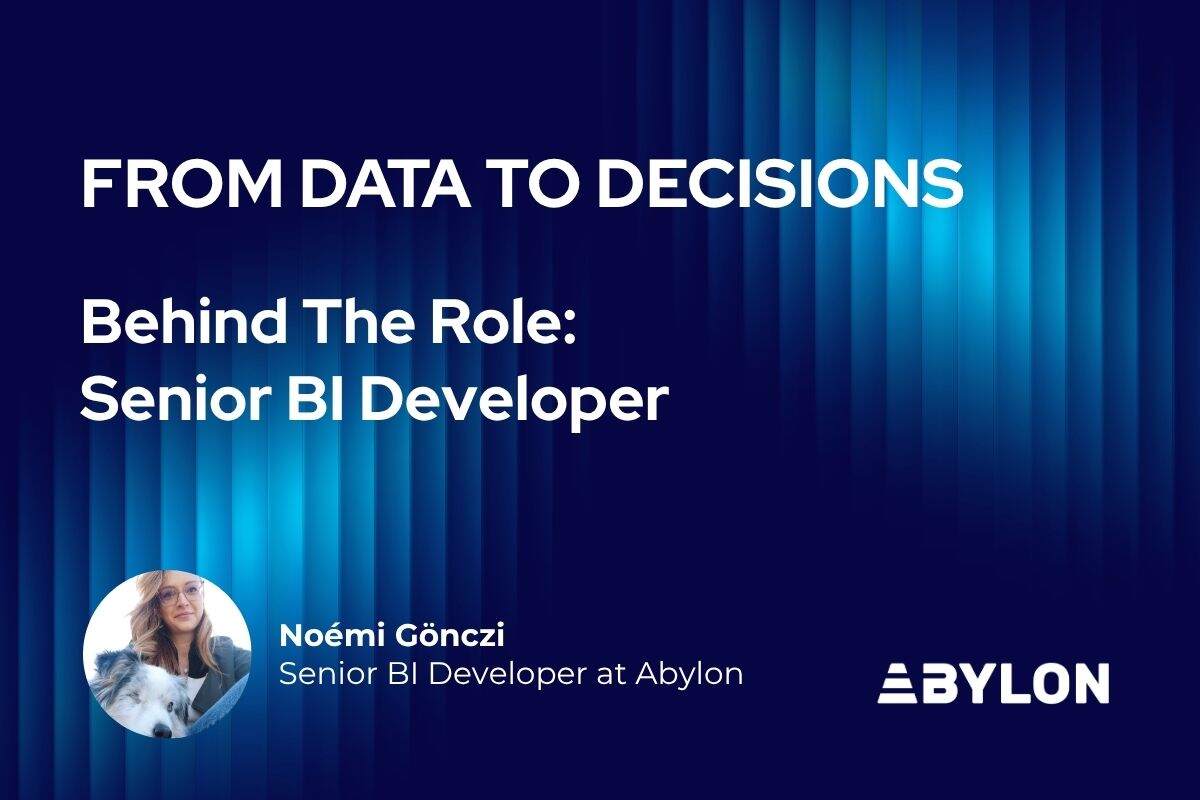
Noémi Gönczi - Senior BI Developer at Abylon Consulting. Linkedin Profile