Enterprise AI Agents That Drive Measurable Impact
Experimenting with AI is relatively straightforward; translating that potential into a secure, scalable capability that delivers sustained business value is considerably more complex.
Many organizations have already tested generative AI through chatbots, copilots or isolated proof-of-concept projects. These initiatives may demonstrate technical potential, but they often remain disconnected from enterprise systems, trusted data and everyday workflows.
Enterprise AI agents provide a more structured and commercially viable route from experimentation to operational impact. Designed correctly, AI agents can understand business context, retrieve relevant knowledge, prepare decisions, use approved tools and complete defined workflow steps. They operate alongside employees as supervised digital colleagues, reducing manual effort while keeping people in control.
How Enterprise AI Agents Extend Business Capabilities
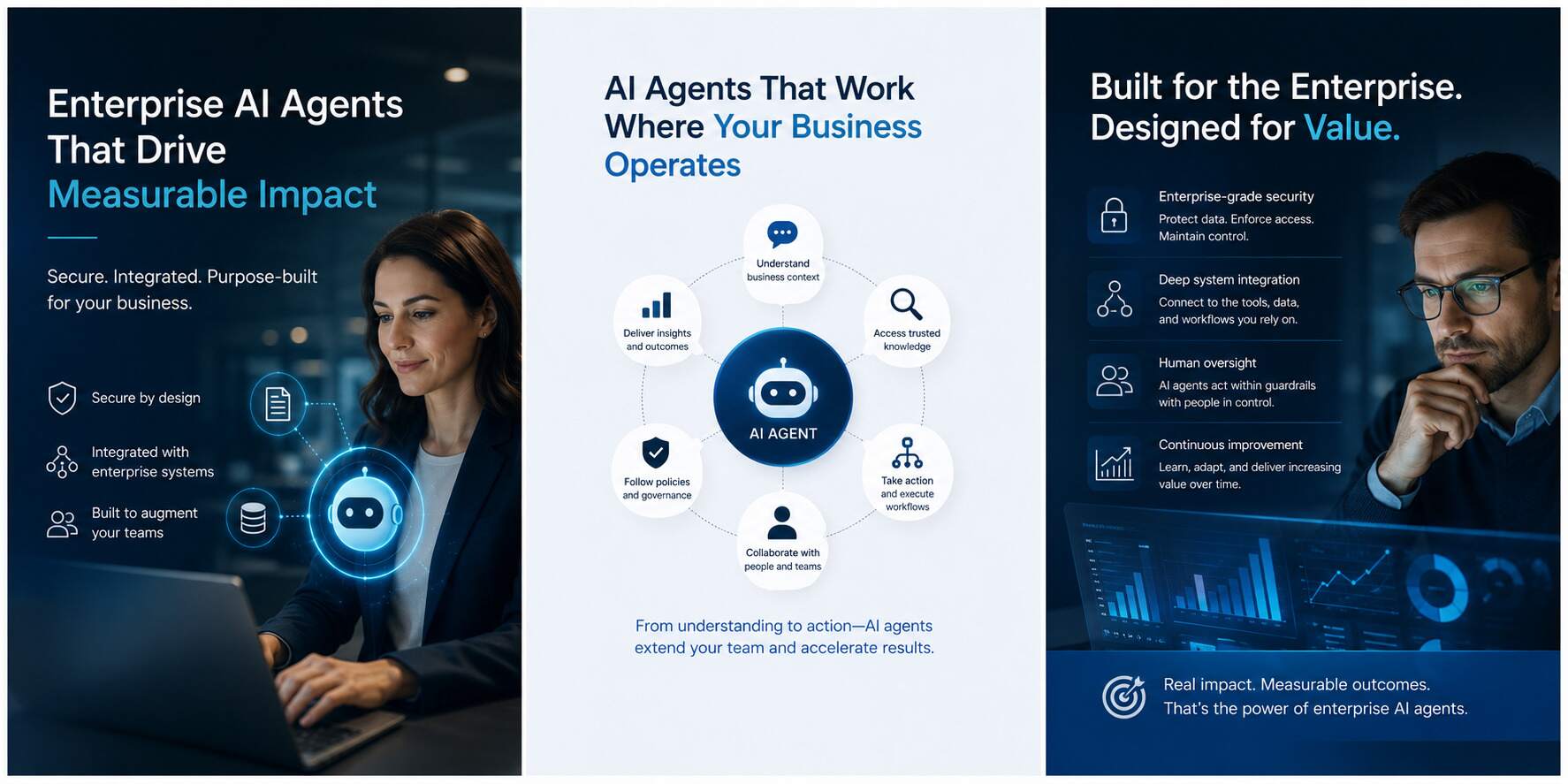
Enterprise AI agents are more than advanced chatbots. A chatbot typically answers a question. An AI agent can analyze a request, identify missing information, access enterprise knowledge, recommend an action and initiate the next stage of a business process. Depending on its role and permissions, an AI agent can:
- classify and route incoming requests,
- summarise and analyse documents,
- extract important information,
- prepare responses or recommendations,
- search approved knowledge sources,
- interact with enterprise applications,
- initiate workflows,
- escalate exceptions for human approval.
This makes AI agents particularly valuable and effective in processes that are repetitive, document-heavy, knowledge-intensive or dependent on several systems and teams.
Where Enterprise AI Agents Deliver the Greatest Impact
The most compelling opportunities for enterprise AI agents often lie not in creating entirely new processes, but in improving the workflows organizations already rely on. They are found in existing workflows where employees spend too much time searching, checking, copying, classifying and coordinating.
- Customer Service and Support
AI agents can classify support requests, detect missing information, retrieve relevant knowledge and route cases to the right specialist. This can improve request quality, reduce unnecessary back-and-forth communication and help support teams respond faster.
- Finance and Procurement
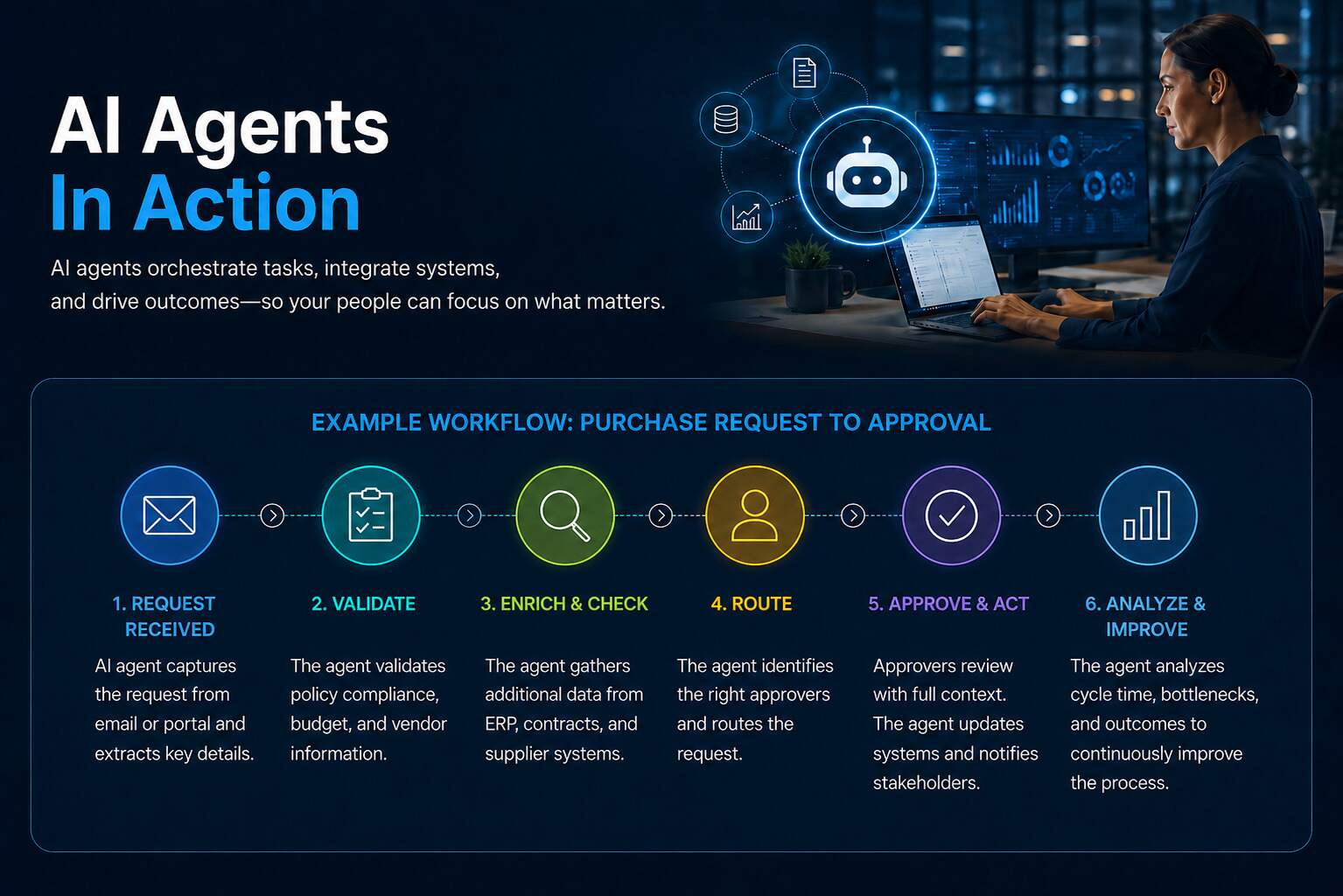
Finance teams often work with complex workflows involving documents, approvals, policies and exceptions. AI agents can support invoice-related processes, purchase requests, document review, financial information preparation and policy checks while escalating sensitive decisions to employees.
- HR and Employee Services
AI agents can help employees find internal policies, navigate onboarding processes, prepare standard documents and receive consistent answers to common HR questions.
- IT Service Management
In IT support, AI agents can categorize incidents, search technical documentation, recommend possible solutions and route complex cases to the appropriate expert.
- Enterprise Knowledge Management
Most organizations already possess valuable knowledge, but it is often distributed across documents, applications, shared folders and departmental systems. AI agents can make this knowledge easier to access while respecting existing permissions and governance requirements.
What Makes an AI Agent Enterprise-Ready?
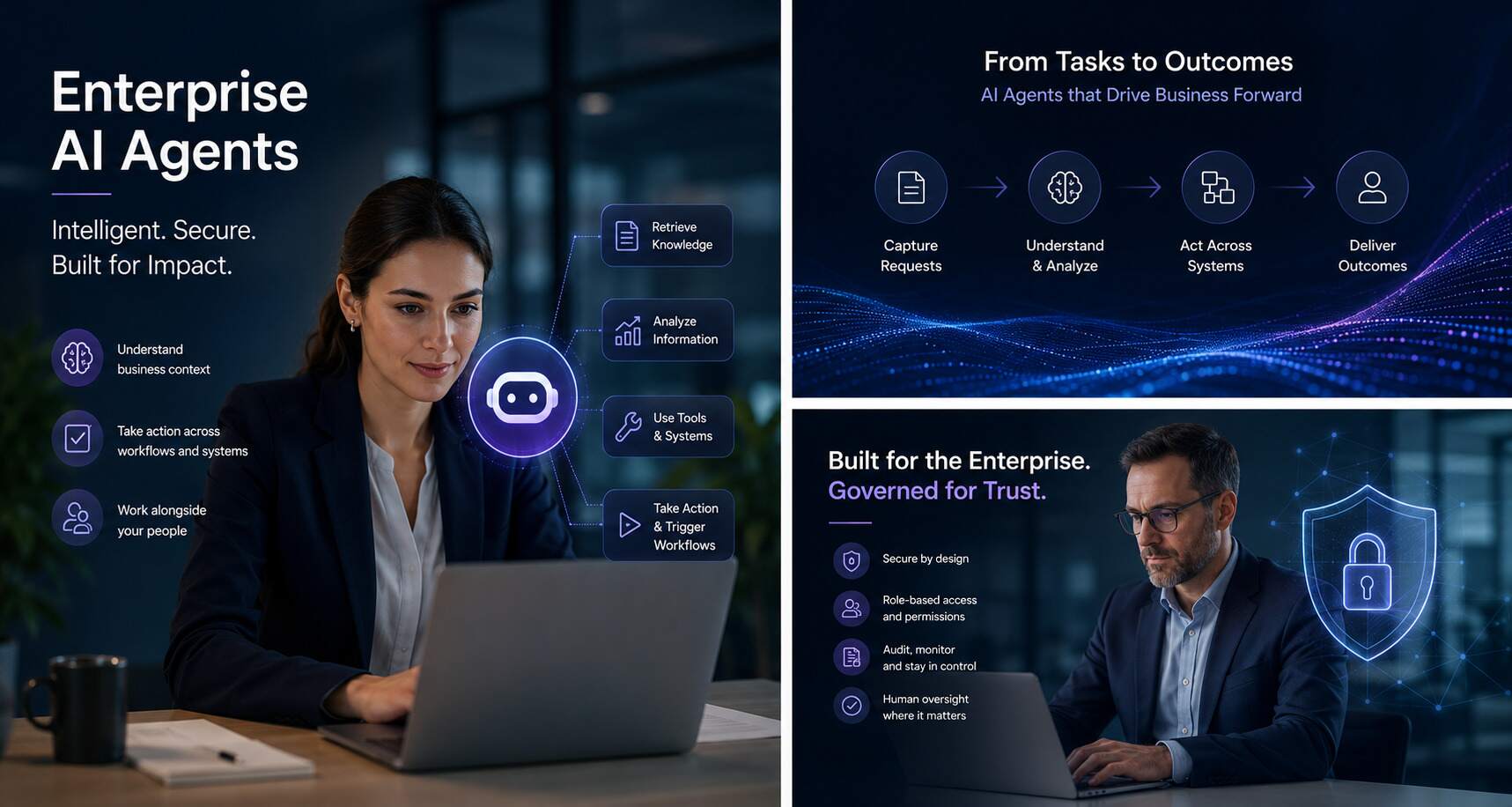
To become a reliable digital colleague, an AI agent must operate within a secure platform, understand trusted business information and follow clearly defined rules.
- Enterprise Grounding
Generic AI models do not automatically understand your internal terminology, processes, products or policies. Enterprise grounding connects the agent to approved company information, including documents, knowledge bases, structured data and business systems. This enables the agent to provide outputs based on relevant organizational context rather than general model knowledge.
- Workflow and System Integration
Real business processes rarely consist of just one question and one answer. They involve multiple steps, systems, approvals, exceptions and handovers. AI agents therefore need to be integrated with enterprise applications, APIs and workflow tools. The business value comes from combining AI reasoning with real process execution.
- Governance and Human Control
Enterprise AI agents must operate within clearly defined boundaries and must be controlled by certain rules.
Organizations need control over:
- what information the agent can access,
- which tools it may use,
- which actions it can perform,
- when human approval is required,
- how activities are logged and monitored,
- how quality, safety and accuracy are evaluated.
The objective is to enable supervised automation that improves productivity while preserving accountability.
From AI Experiment to Enterprise Solution
Building an enterprise AI agent is a business transformation initiative. A successful implementation begins with a clearly defined problem and a realistic workflow. Abylon helps organisations move through the complete delivery journey:
1. Use Case Discovery
We identify processes where AI can create measurable value and assess them according to business impact, feasibility, data availability, risk and implementation complexity.
2. Agent and Workflow Design
We define the agent’s role, users, knowledge sources, tools, workflow steps, escalation points and operational boundaries.
3. Rapid Prototyping
A focused proof of concept validates the business value, user experience, data quality and integration requirements before a larger investment is made.
4. Enterprise-Grade Implementation
The agent is connected to approved systems, APIs, identity services, monitoring tools and deployment environments. Security, privacy, logging and access control are designed into the solution from the beginning.
5. Testing and Controlled Rollout
The solution is tested for answer quality, workflow completion, grounding accuracy, tool usage, safety and edge cases before wider adoption.
6. Continuous improvement
Enterprise AI agents become more effective over time through continuous evaluation of usage patterns, employee feedback, evolving business rules, expanding knowledge sources, and insights gained from observed errors.
A Practical Starting Point: One Workflow
Start with one business process where manual effort, slow information access or repeated coordination creates a visible cost. A focused Abylon AI agent proof of concept typically takes 8–12 weeks and can include:
- a working AI agent prototype,
- workflow and solution architecture,
- enterprise knowledge integration,
- selected system connections,
- testing and evaluation,
- production recommendations,
- an implementation roadmap.
This approach gives decision-makers a tangible solution to evaluate and creates a clear path from experimentation to production.
Build AI Agents That Work for Your Business
Enterprise AI agents can help your organization improve productivity, accelerate workflows and make business knowledge easier to use. But measurable value requires more than a strong AI model. It requires the right use case, trusted data, secure integration, effective governance and a delivery partner that understands enterprise operations.
Download our Solution Guide and start planning your modernization journey with confidence.

Author of the post:
Attila Dömsödi - Head of Application Development at Abylon Consulting. Linkedin Profile