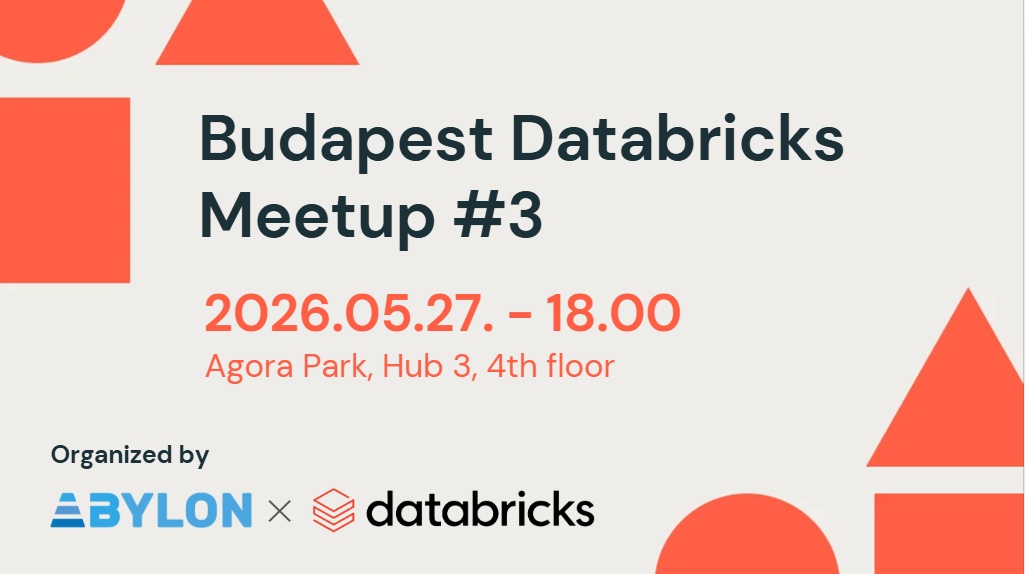
Budapest Databricks Meetup #3: Metadata, AI, and SAP Integration in Practice
The next Budapest Databricks Meetup, organized by Abylon, will take place on May 27. Once again, we’re bringing together Budapest’s data and AI community for an evening of knowledge sharing, practical insights, and professional networking.
The third meetup will focus on the role of metadata in enterprise AI, the practical application of end-to-end data lineage, and the integration of SAP and Databricks systems. Drawing on real-world project experience, the event will demonstrate how to build more transparent, intelligent, and better-integrated data platforms.
Participants will gain practical insights from experts who work with Databricks environments and modern enterprise data platforms every day. Topics will include how metadata can support next-generation AI solutions, how lineage-based approaches can help identify the causes of KPI changes more quickly, and how to efficiently integrate SAP data into Databricks platforms.
The event is particularly relevant for data engineers, data analysts, BI professionals, and AI experts, but it will also appeal to anyone interested in modern data platforms and the Databricks ecosystem.
If you work with Databricks, build enterprise data platforms, or want to deepen your understanding of SAP and AI, join us! After the presentations, there will also be plenty of opportunities for networking and professional discussions.
Our Speakers
Miguel Angel de Luna Gomez (Practice Lead EMEA, Databricks) – xploring how metadata is transforming enterprise AI solutions and how Databricks is helping shape the future of intelligent data platforms.
Vedelek Edina & Vetési Olivér (Abylon Consulting) – Exploring end-to-end lineage approaches across Databricks and Power BI environments to provide greater transparency into KPI changes and report dependencies.
Takács Gábor (Abylon Consulting) – A practical look at integrating SAP data into Databricks environments, including common challenges and a data engineering perspective.
If data, innovation, and community matter to you, don’t miss out! Join the Budapest Databricks Meetup Group and become part of our professional community.
We use cookies on our website to improve your browsing experience. By clicking “Accept”, you consent to the use of all these cookies. However, you may visit "Cookie Settings" to provide a controlled consent. Cookie settingsACCEPT
Privacy & Cookies Policy
Privacy Overview
This website uses cookies to improve your experience while you navigate through the website. Out of these cookies, the cookies that are categorized as necessary are stored on your browser as they are essential for the working of basic functionalities of the website. We also use third-party cookies that help us analyze and understand how you use this website. These cookies will be stored in your browser only with your consent. You also have the option to opt-out of these cookies. But opting out of some of these cookies may have an effect on your browsing experience.
Necessary cookies are absolutely essential for the website to function properly. This category only includes cookies that ensures basic functionalities and security features of the website. These cookies do not store any personal information.
Any cookies that may not be particularly necessary for the website to function and is used specifically to collect user personal data via analytics, ads, other embedded contents are termed as non-necessary cookies. It is mandatory to procure user consent prior to running these cookies on your website.