Citizen Data: Power to the People
The Problem That Sneaks Up on You
Sometimes you live with a problem without even realizing it. You can’t explain it, you don’t believe there’s a solution — so you just accept it.
That’s exactly what happened to me.
I was working on several projects, unintentionally creating what you might call Shadow IT. (Read more on Shadow IT and Shadow Finance)
Meanwhile, the official IT department did everything it could to limit my capabilities. They simply wouldn’t support anything I tried to build. Eventually, I left. And, as you might guess, everything I had built collapsed overnight.
When I moved into IT consulting, I started meeting a lot of citizen developers: controllers, analysts, and business experts who were maintaining critical business data… entirely in Excel.
It was like watching someone try to build a house with one hand tied behind their back.
So, what’s a citizen developer? According to Gartner:
“A citizen developer is an employee who creates application capabilities for consumption by themselves or others, using tools that are not actively forbidden by IT or business units. A citizen developer is a persona, not a title or targeted role. They report to a business unit or function other than IT.”
The Main Pain Points
Through these conversations and projects, I saw the same issues again and again:
1. Asynchronous Speed Expectations
In the organizations I worked with, IT and data warehouse teams were already under immense pressure. They pushed back on change requests just to stay afloat. Meanwhile, the business side didn’t slow down for a second. Leaders pushed their controllers and domain experts to deliver new reports yesterday.
The result? A painful mismatch in speed expectations: IT slowed the pace, the business demanded instant results, and citizen developers were stuck in the middle — desperately trying to keep up.
2. One Hand Tied Behind the Back
Citizen developers are resourceful. Many taught themselves SQL, Power BI, and even built small automations to refresh their Power BI datasets.
But some tasks required full control over data pipelines — something they didn’t have.
Instead of creating a scheduled job to run a long query overnight, they spent hours manually logging in, starting the query, and waiting… only to have it time out.
3. No Central Support or Governance
The next logical step was to integrate these pipelines into the official data warehouse environment.
But the DWH team couldn’t do it quickly. They lacked the platform, people, and time to provide centralized governance, maintenance, and integration for these citizen-built pipelines.
4. No Versioning, Logging, or Access Control
The official DWH platform had all the hallmarks of a robust, developer-friendly environment:
- IDE support
- Git and source control
- Versioning
- Advanced pipelines
- Centralized monitoring and logging
- Access control and storage management
- Automated backups
Citizen developers had none of that. They were working directly in production, every single day, without the safety nets that professionals take for granted.
What If They Had All This?
Now imagine if citizen developers did have these capabilities, but with a user-friendly, business-focused twist:
- A visual, step-by-step GUI for building data pipelines. Perfect for professionals without a development background, as it allows for intuitive and incremental building
- Central logging and monitoring. Everything tracked, nothing lost, and teamwork made easier.
- Infrastructure handled by the IT and infrastructure teams
- Built-in source control and versioning
- Advanced data capabilities: AI, cleaning, transformation, plus easy visual integration of predictive and machine learning models into workflow
- Centralized access control
- Built-in front-end tools: such as dashboards and applications that support data-driven decision-making at the leadership level
That’s where platforms like Dataiku come in.
Dataiku brings all these capabilities together in one place, empowering citizen developers with the tools they need to work faster and smarter, while giving IT the governance, security, and scalability they require. By combining an intuitive, no-code/low-code interface with enterprise-grade controls, Dataiku bridges the gap between speed and safety. This ensures business teams stay agile without bypassing essential IT processes.
One of Dataiku’s key advantages is that nearly every element of the workflow is available within a single platform, eliminating the need to juggle between different tools. Chat, task management, data handling, and version control are all in one place, which significantly streamlines daily operations, reduces the risk of errors, and speeds up collaboration between teams.
From my perspective, that’s exactly why we partner with them: they give the power back to the people and the data back to the citizen developers.
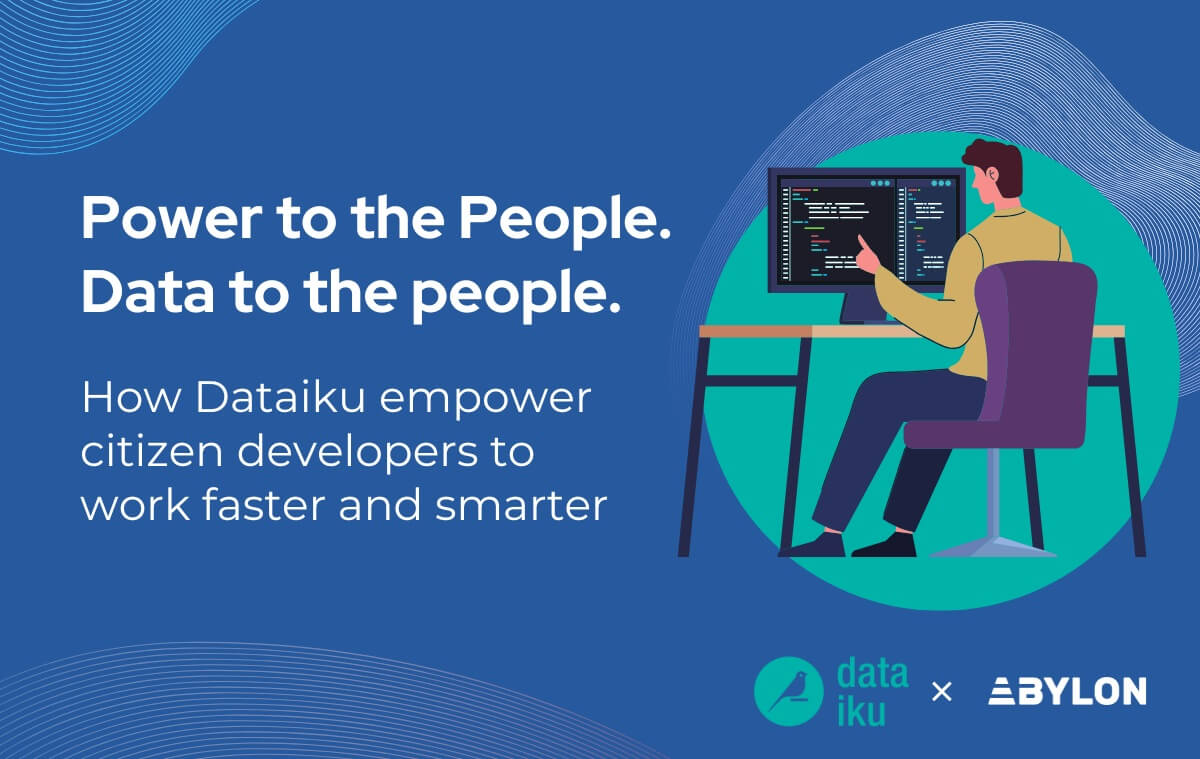
Power to the people. Data to the people.
Curious About Dataiku?
If you feel like you’ve been facing the same challenges, or if this topic simply resonates with you, let’s have a quick chat. With our Dataiku consulting services, we help teams empower their citizen developers, work faster without sacrificing governance, and turn data initiatives into real business impact.
Other popular related blogposts:

Author of the post:
Zsolt Kreisz - Financial Controller in the past, now BI Developer at Abylon Consulting. Linkedin Profile