The AI & BI Revolution: Solving business problems with Databricks AI/BI and Databricks Genie
Introduction
Data driven decision making today is not a privilege but an expectation. For organizations, fast, accurate and contextually interpreted data based answers are indispensable. This is hardly news. Yet not everyone is a data scientist or analyst.
Databricks AI/BI offers a complex solution to this challenge combining the advantages of artificial intelligence (AI) and business intelligence (BI).
The system has two pillars:
- the AI supported dashboard interface that enables visualization and decision support in a low code way, and
- Genie the natural language conversational interface that allows business users to ask questions directly about their data.
What is AI/BI in Databricks

Source: Databricks
The goal of Databricks AI/BI is to turn traditional BI tools into solutions powered by artificial intelligence. It is not a separate product but an integral part of the Databricks Platform, uniting data processing, analysis, and visualization.
AI/BI Dashboards
An AI-supported, low-code dashboard solution that includes all key BI functions and provides quick answers to defined business questions.
The goal is to make data exploration and decision support fast, intuitive, and accessible — even without technical skills — directly within the Databricks platform.
How Does Genie Work?
Genie is a complex, multi-component system that covers the entire process from data interpretation to visualization.
Its operation is based on the following main steps:
1. Understanding natural language
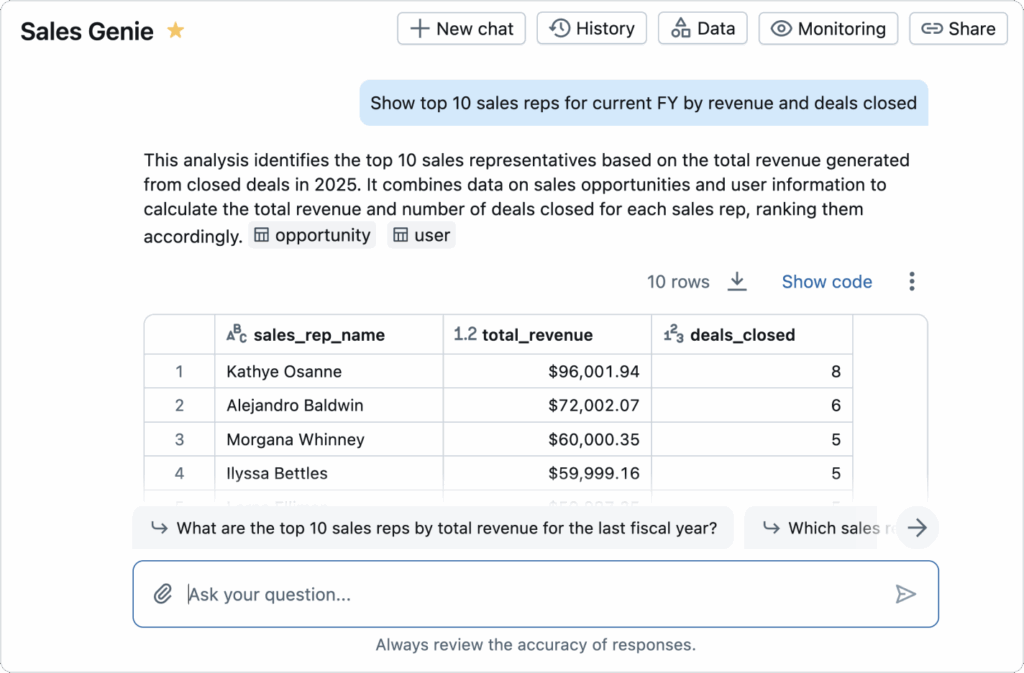
The user can ask simple questions such as:
“Which of our products grew the fastest in the last quarter?”
Genie analyzes the question, identifies key concepts (time, metric, entity), and maps them to the data model.
2. Generating and running the query
The system uses metadata from Unity Catalog and the knowledge store to select the relevant tables and fields, then generates an SQL query for Databricks.
The query runs in read-only mode, so no data is changed.
3. Displaying the visual and textual response
Genie executes the query and immediately visualizes the result in a chart, table, or short textual summary.
The user can further refine the questions, for example:
“Filter only for the European region.”
“Show it by month.”
The Databricks Genie Space and The Knowledge Layer
Genie operates through Genie spaces. These are configured environments where the system understands a predefined part of the organization’s data structure and terminology.
What does a Genie space contain
- Metadata and descriptions: table and column level information from Unity Catalog.
- Synonyms and conceptual mappings: for example, if someone writes “revenue” instead of “sales,” Genie recognizes it.
- Sample queries: examples from which the system learns the correct context.
- Trusted assets: queries, logic, or functions verified by the administrator.
These components allow Genie not only to give generic answers but to speak the company’s own business language.
Advantages of Genie’s operation
- Fast response time – real-time interaction with data in Databricks.
- No technical skills required – users work in natural language.
- Consistent access – all objects under Unity Catalog, including Genie, share unified permission management and auditability.
- Visual interactivity – results can be displayed, filtered, and refined instantly.
- Integration of organizational knowledge – Genie space metadata ensures the system adapts to the company’s context.
What happens if Genie cannot answer
Genie can recognize when it lacks sufficient context or when a query cannot be interpreted.
In such cases, it asks the user to clarify the intent. This guided refinement feature is one of the main differences between Genie and a simple chatbot.
Databrick Genie - In Practice
Source: Databricks
This is still a relatively new area, so practical experience is currently limited. However, some of our colleagues recently took part in our Bootcamp organized jointly with Databricks, where they had the opportunity to explore the Databricks AI/BI and Genie solutions in practice.
Below a quick recap form our data engineer colleagues Csilla Janky and Balázs Kovács who shared their fresh experiences after the bootcamp:
It’s exciting to see how the Databricks platform takes data innovation to a new level and enables business users to create real value from their organization’s data.
We would highlight a few new features that specifically make collaboration between business users and developers easier. For example:
- Trusted assets (with parameterized sample query)
As an engineer, Databricks Trusted Assets with parameterized SQL queries are particularly useful because they save time and reduce support load. Instead of writing the same queries each week for different teams with minor variations, I can write a complex logic once with parameters, optimize and test it, and then anyone can use it in natural language without technical knowledge.
- Talk to your Dashboard
The key point is that this functionality replaces ad hoc dashboard development. Once the dashboard is built with the right metadata and context, the natural language interface allows stakeholders to explore data themselves, ask “what if” questions, and get answers. The biggest advantage for me is that I can finally build dashboards that are not static reports but living, interactive interfaces where the AI understands the underlying data model, metric definitions, and business logic, thus generating intelligent, context-aware responses.
- Monitoring
The Databricks Genie monitoring function provides transparency on how the AI-based analytics tool is used across the organization and what quality of answers it produces. In one central place, I can see which queries perform well, where the system fails, and where the data model or metadata needs tuning, allowing me to improve proactively instead of reacting to user complaints.
Summary
Databricks AI/BI is an intelligent analytics hub that combines all the strengths of the Databricks platform – security, unique data access, scalability – with natural language interaction through Genie.
Genie is not just another chatbot for data but a specialized tool for business users seeking data-driven solutions.
- Dashboards answer validated, static business questions.
- Genie answers new, ad hoc, natural language questions dynamically.
- Both are built on the same secure data platform, providing a unified, reliable, and scalable analytical experience.
Want to Harness The Power of Databricks Genie?
Many organizations struggle not only to collect data but to truly interpret and utilize it. Databricks AI/BI and Genie help turn data into a real decision support tool instead of just a collection of reports.
If you are interested in how to create real business value from your data, get in touch with us and we will show you how to get more out of your data.