
Author of the post:
Zsolt Kreisz - Financial Controller in the past, now BI Developer at Abylon Consulting. Linkedin Profile

Business analysis is often seen as a technical or formal discipline, filled with diagrams, documents, and stakeholder interviews. But sometimes, the deepest lessons come from the most unexpected places: like a book for toddlers.
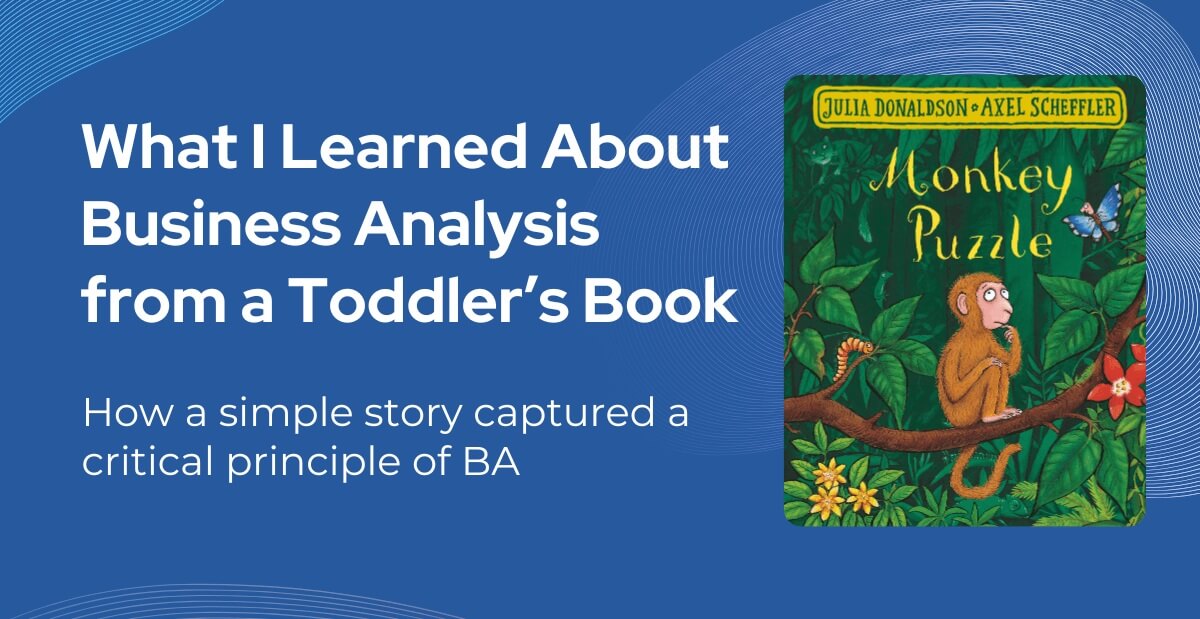
Recently, I read a children’s book called “Monkey Puzzle” (translated as “The Monkey’s Mom” in some editions), and it struck me: this simple story captured one of the most critical — and most overlooked — principles of effective business analysis.
Let me explain.
In our work, business analysis usually has a well-defined, narrow scope. We’re there to support the development process:
And that’s where it ends. We’re not embedded in the organization. We don’t go department-hopping to look for synergies. We’re on the supplier side. We deliver a product or a solution. That’s our job.
Not just through artifacts and diagrams, but by building understanding. By helping all parties clarify what they really need, not just what they say they want.
And that’s exactly what “The Monkey’s Mom” reminded me of.
The story is simple:
A little monkey loses his mom. A butterfly offers to help him find her. The monkey starts describing her:
“She’s big!”
“She has a tail!”
“She climbs trees!”
With each clue, the butterfly brings a new animal: an elephant, a spider, a bat, a snake…
Each time, the monkey is frustrated — “That’s not my mom!”
Eventually, the monkey bursts out: “None of these animals even look like me!”
To which the butterfly calmly replies: “You never said she looked like you.”
And adds:
“My babies don’t look like me. They’re caterpillars.”
The butterfly made a perfectly rational assumption based on its own world, but that assumption didn’t apply to the monkey’s world.
And the monkey made his own assumption that the butterfly would just know that his mom must look like him.
Miscommunication often comes not from bad intent or lack of effort, but from invisible mismatches in assumptions.
And the worst part?
We don’t realize they’re assumptions until something breaks.
This book gave me a crystal-clear metaphor for the danger of hidden assumptions and the power of surfacing them early.
Here’s what I took away:
Shared understanding starts with open conversation. Even in a limited-scope engagement, we can take time to ask, “What are we assuming here?”
Diverse backgrounds mean diverse mental models. Never assume people see the world the same way, especially across departments, industries, or cultures.
A “requirement” is just a guess until it’s understood. Real value comes not from delivering a checklist, but from making sure what we build actually solves the business need.
Sometimes the best reminder of how people think, speak, and misunderstand each other comes not from textbooks, but from bedtime stories.
So next time you’re in a requirements workshop, and things feel unclear or misaligned, just remember the butterfly and the monkey.
Ask:
“What might we be assuming here?”
You might just save the project.
Zsolt Kreisz - Financial Controller in the past, now BI Developer at Abylon Consulting. Linkedin Profile

Technical insights, tips, tricks and news!